every language tells you how it first tasted tea
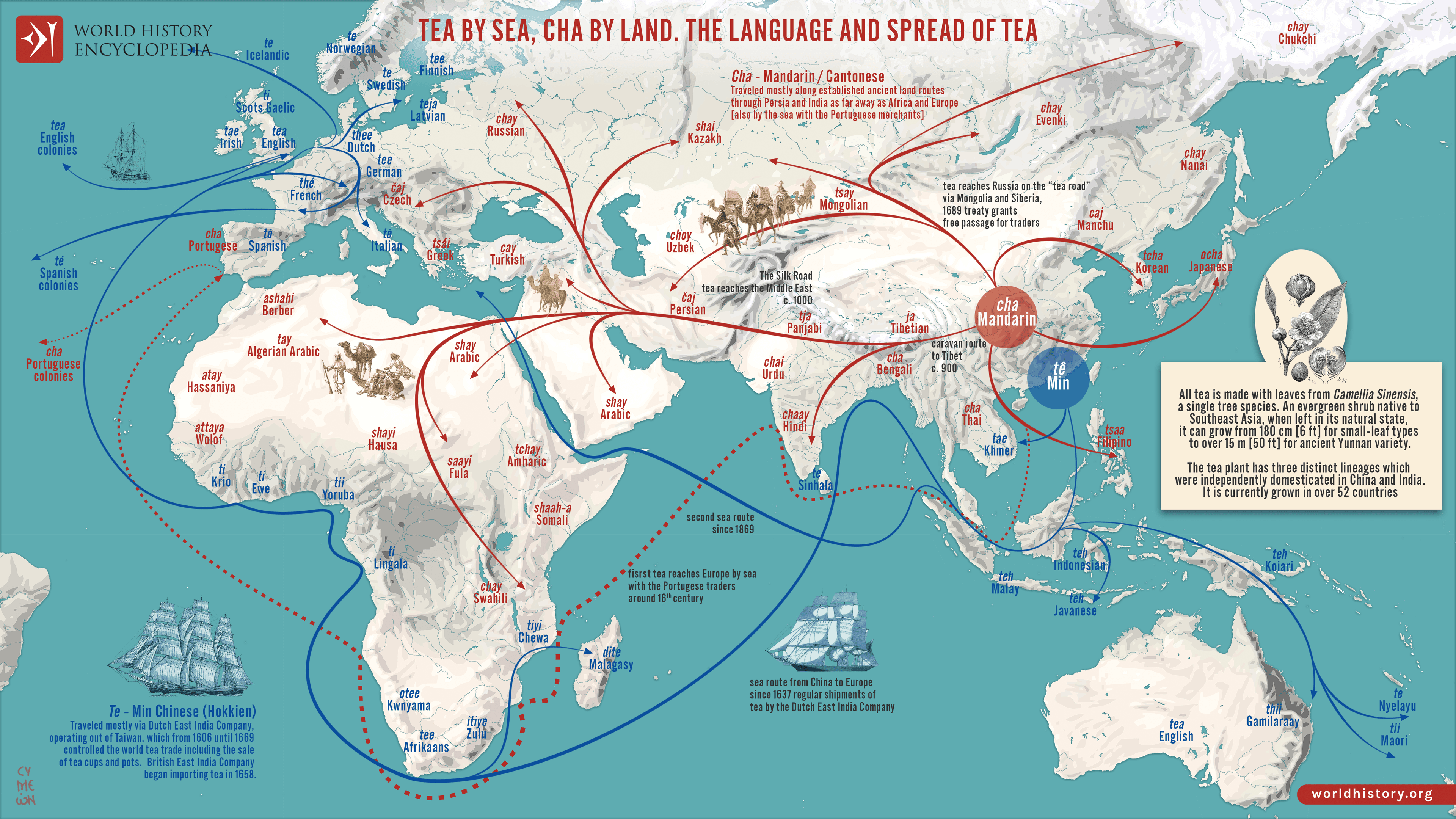
The global tea/cha isogloss — your word for tea tells you how your ancestors got it.
Wikimedia Commons — Fortune, Robert, 1813-1880
View sourceEvery word for tea on Earth comes from a single Chinese character: 茶. But depending on whether your ancestors got their tea by land or by sea, you say one of two things. You either say some version of "cha," or some version of "te."
That's it. Two syllables. And between them, they map the entire history of global trade.
I've been sitting with this fact for days and I still can't get over it. You walk into a chai tapri in Mumbai, order your cutting chai, and the word you use traces an unbroken line back through Persia, through Mongolian caravans, through the Silk Road, all the way to Mandarin-speaking northern China. Your friend in London orders "tea" and that word traveled a completely different route, through the humid ports of Fujian province, onto Dutch trading ships, across the Indian Ocean to Amsterdam, and from there to every Atlantic coastline.
Same plant. Same character. Two pronunciations. Two thousand years of human movement fossilized in a syllable.
before tea became commodity
The plant itself, Camellia sinensis, is older than any empire that fought over it. Its homeland is a fan-shaped region spanning the upper Brahmaputra, northeastern India, northern Myanmar, Yunnan, Sichuan. Indigenous Austroasiatic and Tibeto-Burman peoples were chewing and brewing its leaves for millennia before any Chinese emperor cared about it.
The original word wasn't even Chinese. Historical linguists trace it to a Mon-Khmer root, *la, meaning "leaf." The Burmese word laphet, for the pickled tea they still eat as food, preserves this root almost unchanged. Burma might be the only place that remembers what tea was before it became a commodity, before it became an empire's obsession, before it became the thing that connected every trading civilization on the planet.
When Sinitic-speaking peoples migrated south into Yunnan and met these Austroasiatic communities, they borrowed the word. Then the machinery of Chinese phonology went to work. *la became *lra became *dra. By around 500 CE, Middle Chinese had settled on a retroflex d sound. One pronunciation, one ancestor. And then that ancestor had children.

Burmese laphet thoke — tea eaten as food, not drunk. The oldest surviving relationship between humans and the tea leaf.
Wikimedia Commons / Allervous
View sourcehere is where the split happens
In most of China, the word evolved into something like "cha." Mandarin, Cantonese, Hakka, Gan, all the dialects covering three-quarters of the Chinese landmass, they all said some version of cha. This is the word that traveled overland. Silk Road merchants carried it west. The Tea Horse Road carried it into Tibet (where it became ja). Persian traders on the Silk Road sold it as cha-ye khatai, "tea of China," and their Turkic-speaking customers, mishearing the genitive suffix as part of the word itself, started calling it chai. That's how you get Turkish cay, Arabic shay, Russian chay, Swahili chai, Hindi chai.
Every chai you've ever had carries the ghost of a Persian merchant mispronouncing a Chinese genitive.
But in Fujian province, isolated from the interior by mountain ranges, the dialect went its own way. In Min Nan, the southern coastal dialect spoken around the ports of Xiamen and Quanzhou, the character 茶 underwent a dental shift. The locals said te.
This would have stayed a regional quirk, a linguistic footnote, except for one thing: the Dutch showed up.
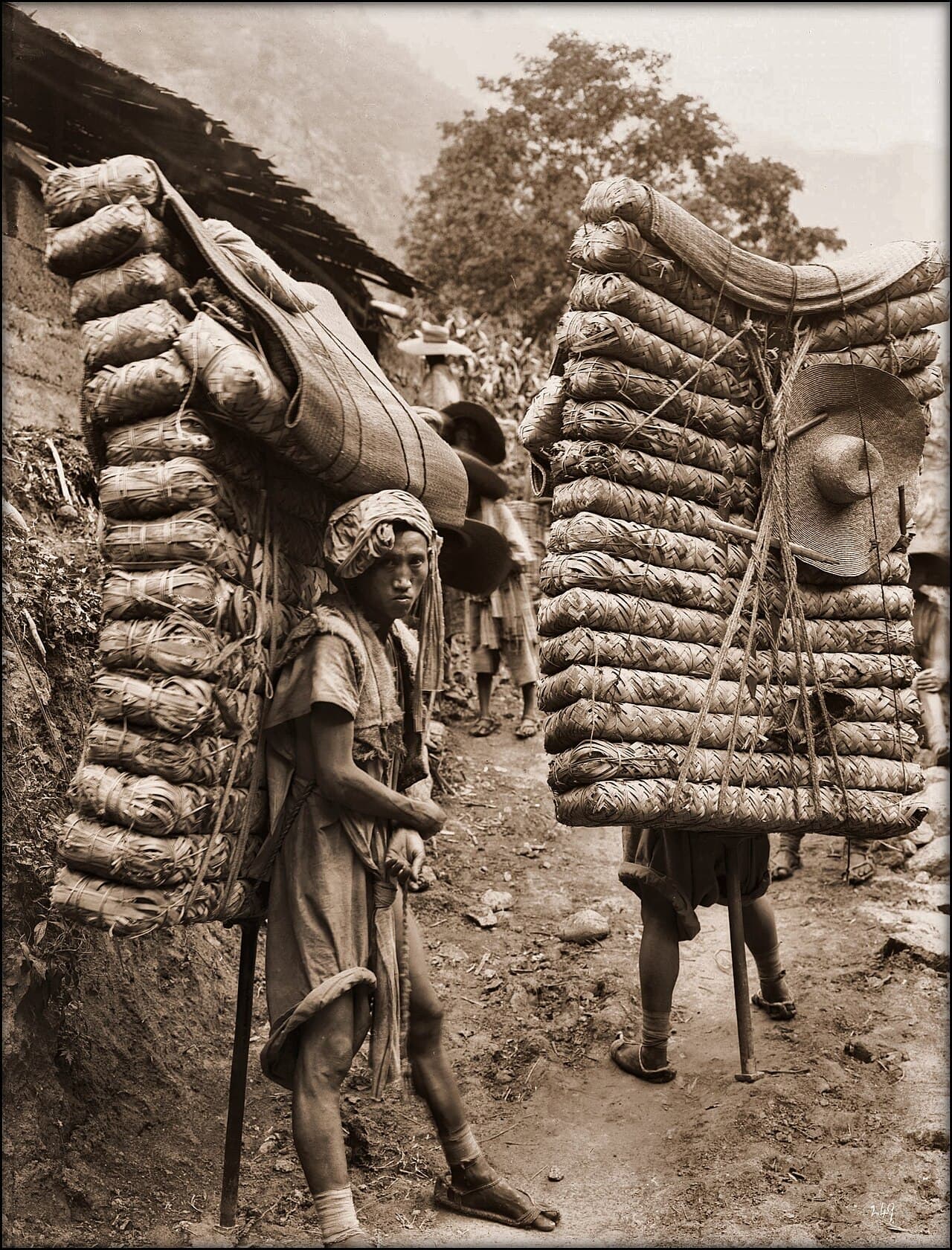
Tea porters on the ancient Tea Horse Road — men carrying loads heavier than their own bodies across the mountains from Sichuan to Tibet.
Wikimedia Commons / ralph repo
View sourceEvery chai you've ever had carries the ghost of a Persian merchant mispronouncing a Chinese genitive.
the maritime word
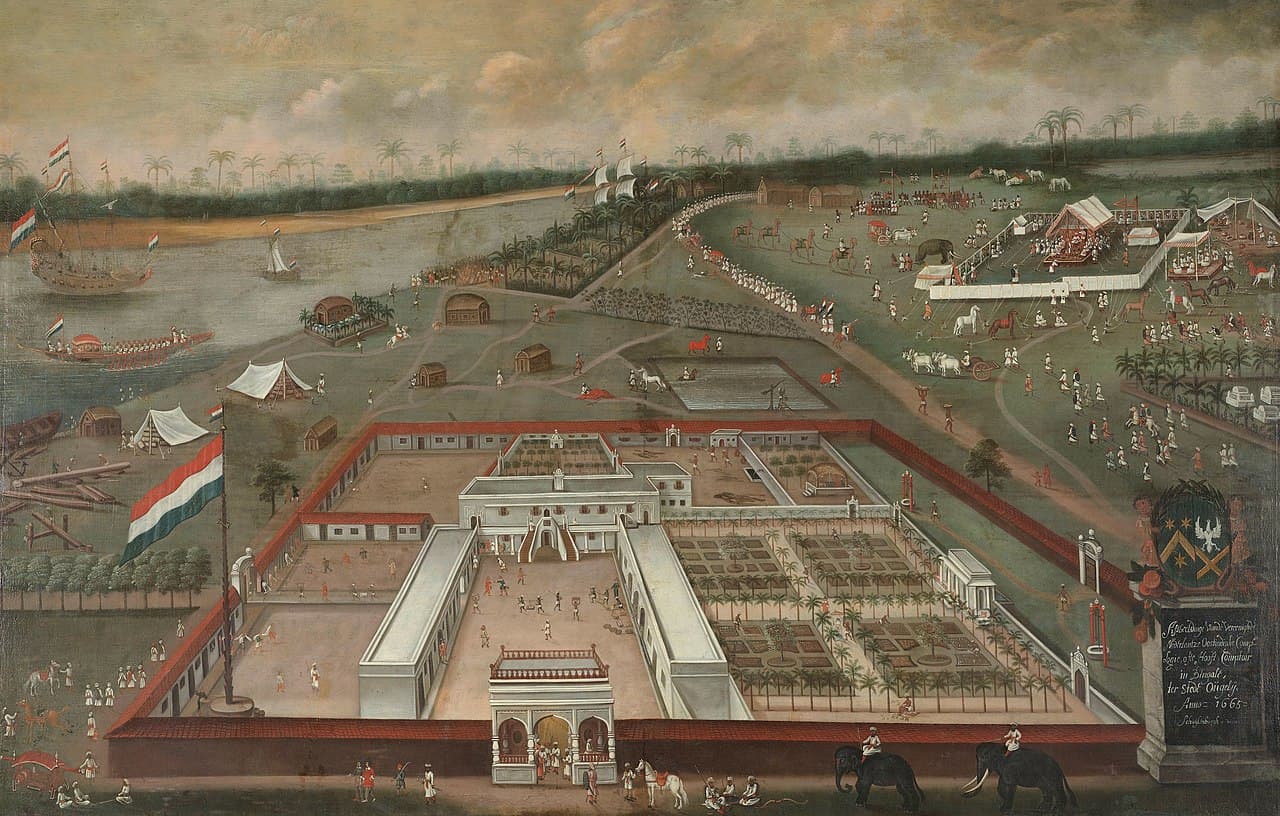
Dutch East India Company ships — the VOC's trade through Fujian ports gave the Atlantic world the word "tea."
Wikimedia Commons / Hendrik van Schuylenburgh
View sourceThe Dutch East India Company, the VOC, was denied access to the Portuguese-held ports of Macau and Canton. So they traded through Fujian. They set up in Batavia, modern Jakarta, and ran their China operations through Xiamen and Taiwan. The locals called it te. The Dutch wrote it down as thee. In 1610, the first official shipment arrived in Amsterdam.
And because the VOC became the dominant tea wholesaler for the entire Atlantic world in the 17th century, their word won. English tea. French the. Spanish te. German Tee. Italian te. All from the Min Nan pronunciation of a single Fujian port town.
When Alexander Pope wrote "The Rape of the Lock" in the early 18th century, he rhymed "tea" with "obey." The word was still pronounced "tay," closer to the original Hokkien. Then the Great Vowel Shift in English dragged the pronunciation from "tay" to "tee," but the spelling stayed frozen. A fossil of a fossil.
and then there is portugal
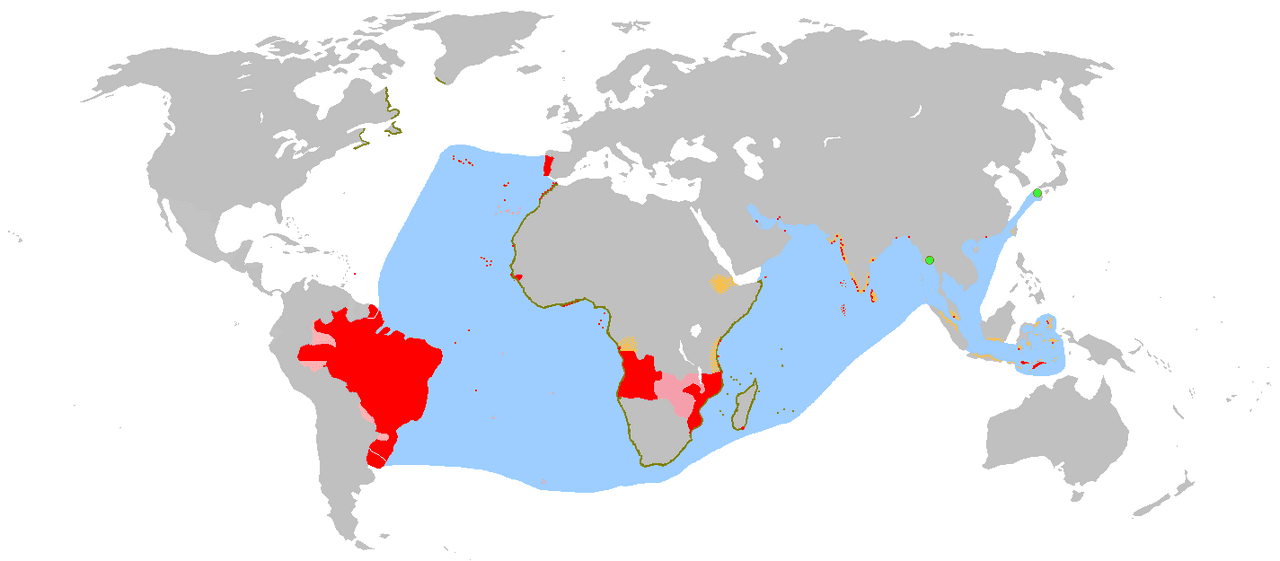
Portuguese Macau — they arrived in Canton decades before the Dutch reached Fujian, and took a different word home.
Wikimedia Commons — The Ogre at English Wikipedia / Later versions by The Red Hat of Pat Ferrick
View sourcePortugal is the exception that proves everything. They're a maritime nation, a Western European seafaring power. By the rule, they should say "te" like their neighbors. But the Portuguese say cha. Because they got there first.
The Portuguese reached Canton in 1515, decades before the Dutch ever touched Fujian. They established a permanent base in Macau in 1557, right in the heart of the Pearl River Delta, where everyone speaks Cantonese. And Cantonese says cha.
So Portugal, Brazil, Mozambique, Angola, they all say cha, surrounded by a continent that says te, because one set of sailors showed up forty years before the other. The entire Portuguese-speaking world carries a different word for the same leaf because of a single generation's head start in the spice trade.
That's how fragile these things are. That's how permanent they become.
caravans, hybrids, and the map
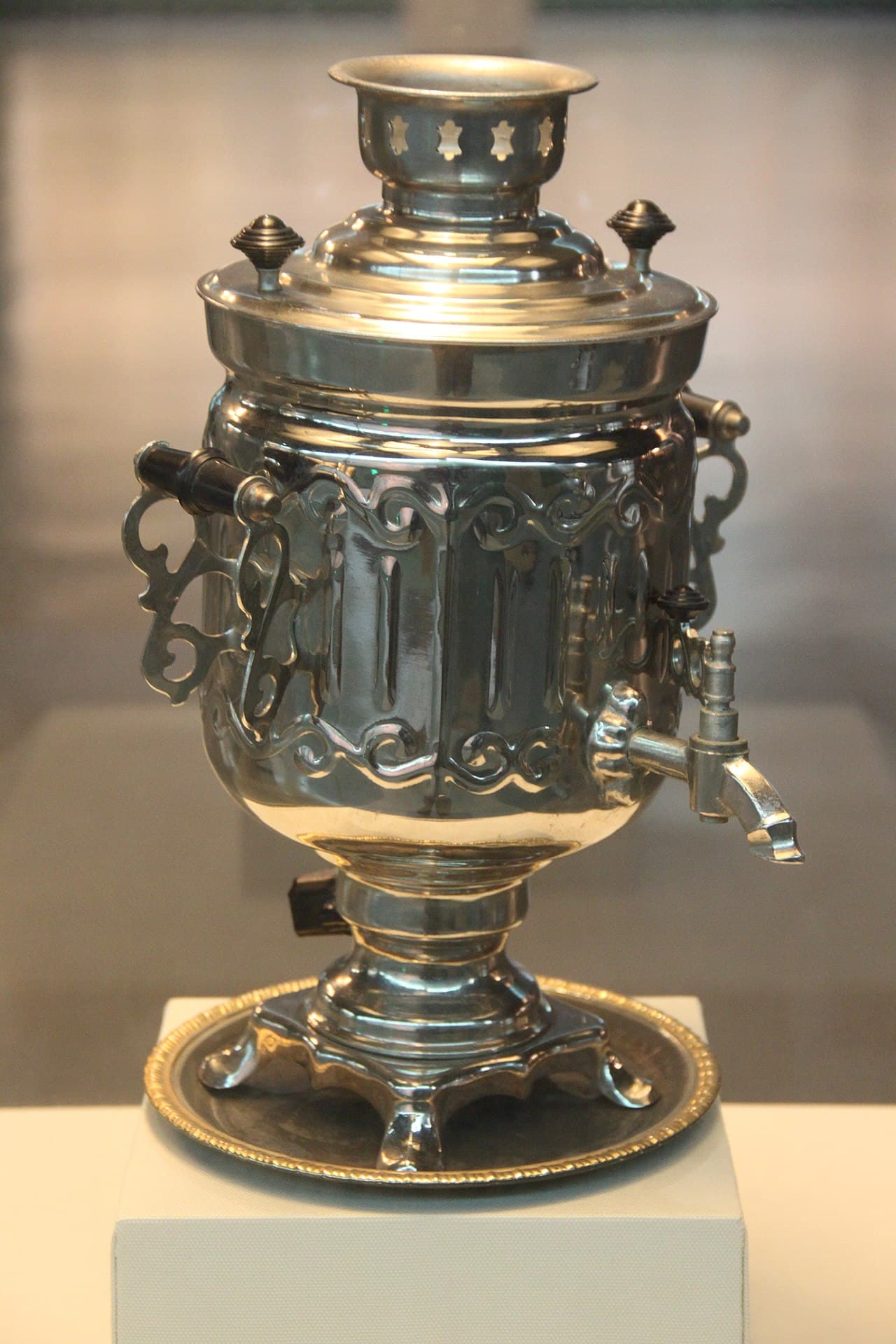
The Russian samovar — tea arrived by camel caravan from northern China, and Russians say chay to this day.
Wikimedia Commons / Gary Todd
View sourceThe Russians got their tea by camel. In 1638, ambassadors to a Mongolian Khan received 200 packets of tea as a diplomatic gift and called them "dead leaves." They came around eventually. The Treaty of Kyakhta in 1727 formalized a massive caravan route from northern China through Mongolia across the Siberian steppe, a journey that took sixteen to eighteen months. The tea picked up a smoky flavor from the nightly campfires along the way, which is how "Russian Caravan" tea became a style of its own.
Because the tea came overland, from Mandarin-speaking northern China through Mongolia, Russians say chay.
Japan got its tea from Buddhist monks in the 9th century, directly from Tang Dynasty China, long before the cha/te split mattered to anyone outside the country. They say ocha. They also preserved the Song Dynasty practice of powdered tea, matcha, which China itself abandoned after the Ming Dynasty. So Japan carries a pronunciation from one era and a preparation method from another, two layers of Chinese culture frozen in amber.
In Poland, Lithuania, and Belarus, they say herbata or arbata. From the Dutch herba thee, "tea herb." Because in those countries, tea first arrived not as a drink but as a medicine, sold by apothecaries. The Latin herba got welded to the Dutch-Min te root. A hybrid word for a hybrid introduction. Even the exceptions tell you something.
So here is the map.
If your language says some version of "cha," your ancestors' tea came overland. Through the Silk Road, through Persian caravans, through Mongolian diplomats, through Buddhist monks walking mountain passes. The continental route. Slow, ancient, land-bound.
If your language says some version of "te," your ancestors' tea came by sea. Through the Fujian ports, onto Dutch ships, across the Indian Ocean or around the Cape of Good Hope, into the harbors of the Atlantic world. The maritime route. 17th century, fast, oceanic.
Two words. Two eras of globalization. The first carried by camels, the second by galleons.
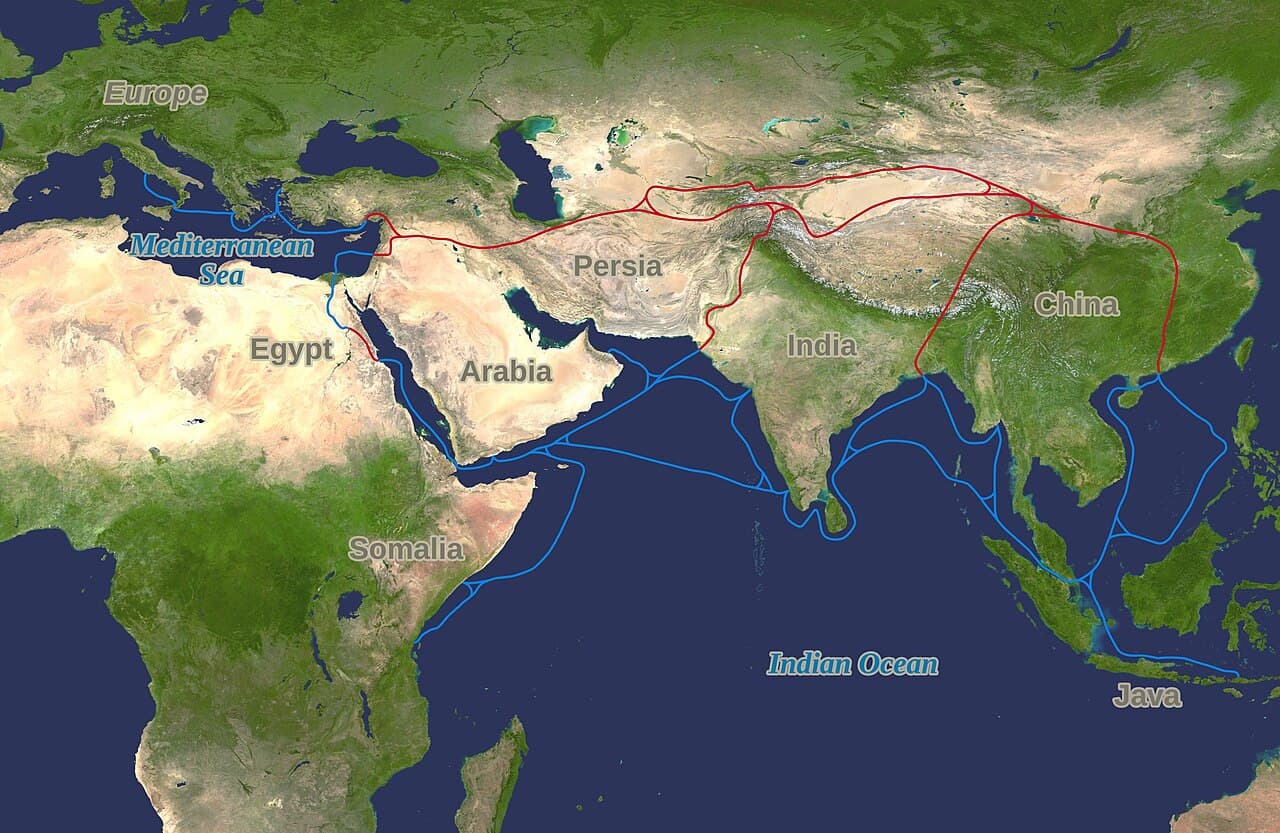
Two routes, two words — the overland Silk Road carried "cha" west, while Dutch galleons carried "te" across the oceans.
Wikimedia Commons — Whole_world_-_land_and_oceans_12000.jpg: NASA/Goddard Space Flight Center; derivative work: Splette
View sourceevery cup is a linguistic fossil
I keep thinking about the Mon-Khmer root, *la. Leaf. Before it was cha or te, before it was a commodity or a ceremony or a trade war, it was just a word for a leaf that grew in the mountains between India and China. The Austroasiatic peoples who first chewed it didn't know it would one day become the second most consumed beverage on the planet, after water. They didn't know their word would mutate through Chinese phonology, split along dialect lines, travel by camel and by ship, get mispronounced by Persian merchants and misspelled by Dutch traders and vowel-shifted by the English, and land, centuries later, in the word you use without thinking when you walk into a cafe and ask for a cup.
Every cup of tea is a linguistic fossil. Every syllable is a trade route.
You just never think about it while you're drinking.
Every cup of tea is a linguistic fossil. Every syllable is a trade route.