the fruit that named a color
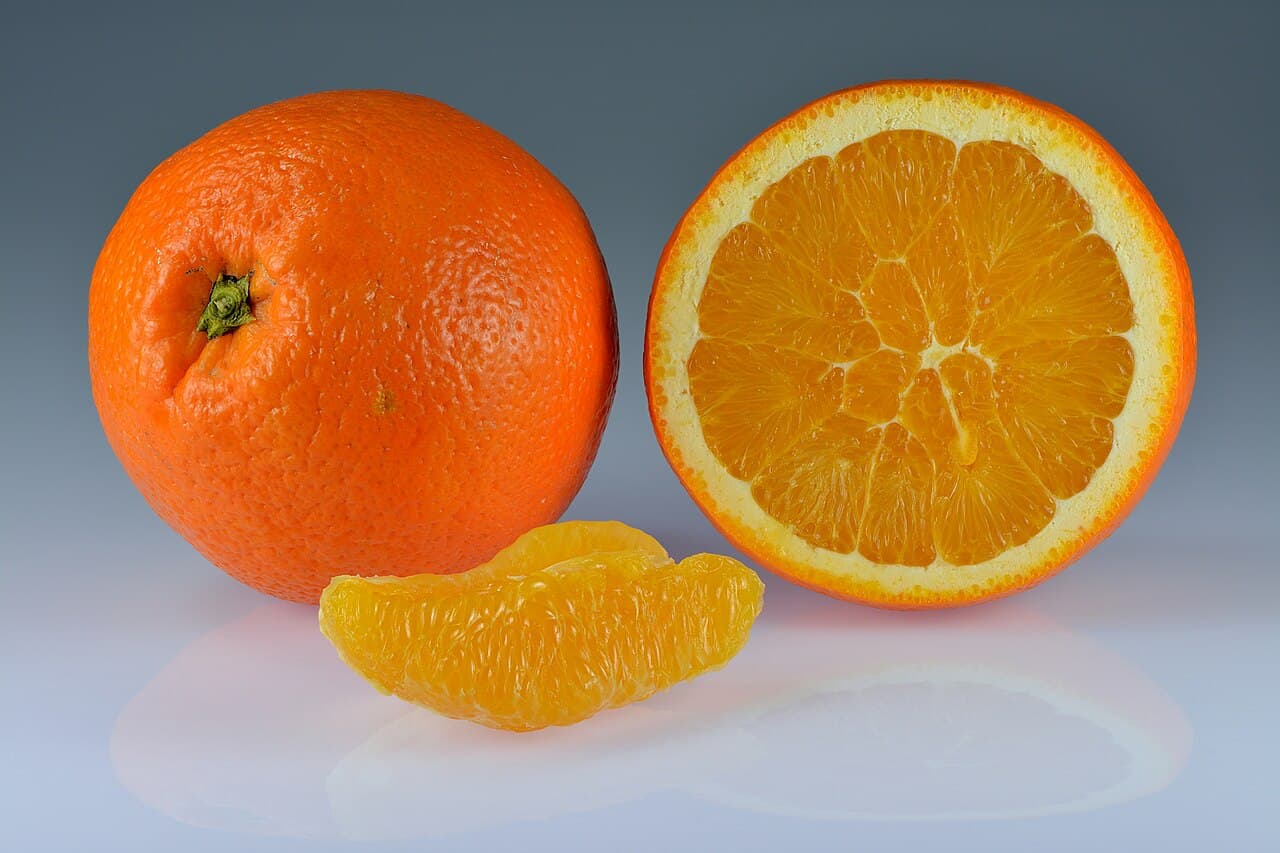
Before the 16th century, English had no word for this color. They called it "yellow-red."
Wikimedia Commons — Ivar Leidus
View sourceThe English language had no word for the color orange until the 1500s. I don't mean it had a word and lost it, or that there was some archaic term that fell out of fashion — I mean the speakers of English looked at sunsets and autumn leaves and the hottest part of a fire for over a thousand years and had nothing better to call what they were seeing than "yellow-red." Old English had a single compound word for the color: geoluhread. Say it out loud and you can hear how inadequate it is. When Chaucer needed to describe the famous fox in the Canterbury Tales, around 1390, the best he could manage was "betwixe yelow and reed." Two hundred years later Shakespeare was still hedging — he wrote "orange tawny," as though even at that late date the word alone couldn't quite be trusted to do the job.
The color didn't get a name until the fruit showed up. Not the other way around.
And the fruit — the word for it, I mean — started as a Dravidian term in southern India, passed through Sanskrit and Persian and Arabic and Italian and French, lost a consonant along the way because medieval English speakers couldn't parse their own grammar, and arrived in the language carrying four thousand years of trade routes, mispronunciations, and cognitive accidents. Every part of that sentence is literal.
The color didn't get a name until the fruit showed up. Not the other way around.
a word named for a smell

Southern India — where the word began. The Dravidian root "naru" meant "fragrant." The fruit was named for its smell, not its color.
Wikimedia Commons — Aalangaram (CC BY-SA 3.0)
View sourceThe word "orange" is not European. It's not even Indo-European, which catches most of the vocabulary we use. It comes from the Dravidian languages of southern India — specifically the root naru, meaning "fragrant," joined to kay, meaning "fruit." Modern Tamil still uses naram for citrus. So the orange was not named for how it looked. It was named for how it smelled. That's a detail worth pausing on, because it tells you something about the priorities of the people who first put a name to it — they were standing in a grove of citrus trees in the heat of southern India, and what hit them first wasn't the color. It was the scent.
As the fruit traveled north through the Indian subcontinent, Sanskrit absorbed the Dravidian term and cleaned it up into naranaga. It shows up in the Charaka Samhita and the Sushruta Samhita, the foundational texts of Ayurvedic medicine, compiled somewhere between 1000 BCE and 200 CE. In those texts the orange isn't a snack. It's pharmacy — a medicinal ingredient, catalogued alongside turmeric and black pepper and hundreds of other plants whose therapeutic properties were being systematically recorded while most of Europe was still in the Bronze Age.
From Sanskrit the word crossed into Old Persian as narang. After the Muslim conquest of Persia in the 7th century, Arabic swallowed enormous quantities of Persian vocabulary — anything to do with agriculture, medicine, trade — but the hard /g/ at the end of narang didn't sit right in Arabic phonotactics. The sound shifted. The word became naranj. And under that name, naranj, Arab merchants carried the bitter orange across North Africa, through Sicily, into Al-Andalus — Islamic Spain.
every border took a piece
Now here's where it gets interesting. The fruit didn't just travel. The word traveled with it. And at every border, every language did something slightly different to the sounds — not deliberately, not by decree, but through the accumulated weight of millions of mouths saying the same foreign word slightly wrong over the course of generations. Spanish took naranj and made it naranja. Straightforward enough. But when the word crossed into Italian, something happened that would echo through every language in western Europe for centuries.
In Italian, a narancia preceded by the feminine indefinite article una became una narancia. Say it fast. Say it ten thousand times across market stalls and kitchen tables and merchant ledgers, the way real people actually talk when they're haggling over the price of fruit and not thinking about etymology. Una narancia. Un'arancia. Somewhere in that blur of repetition the n migrated. Speakers stopped hearing it as part of the fruit's name and started hearing it as part of the article. Just like that — no committee voted on it, no academy decreed it — the orange lost its opening letter.
When the word moved north into Old French it arrived as something like orenge. And here folk etymology delivered the second blow. French speakers, hearing this strange foreign word, unconsciously reshaped it to sound like something they already knew. Oranges were golden. The Latin word for gold is aurum. The Old French word for gold is or. So the initial vowel shifted from a to o — not by design, not through any deliberate act, but by the collective unconscious drift of thousands of speakers reaching for a connection that felt right. Dravidian naru-kay to Sanskrit naranaga to Persian narang to Arabic naranj to Spanish naranja to Italian arancia to French orenge. Every border took a piece.
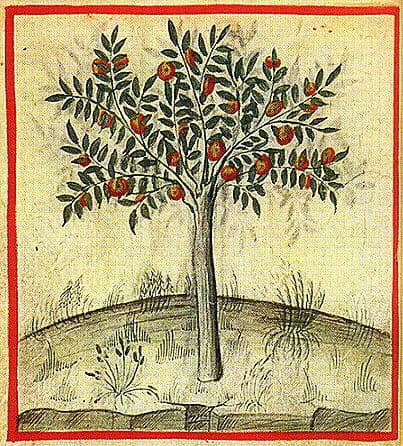
Medieval Italian markets — where "una narancia" became "un'arancia" and the orange lost its opening letter forever.
Wikimedia Commons — unknown master
View sourceEvery border took a piece.
a norange became an orange

English manuscripts from the 1300s — where "a norange" became "an orange" through a simple mishearing that stuck.
Wikimedia Commons — Al-Bukhari (author of text, d. 870). Unspecified copyist.
View sourceThen the word crossed the English Channel. And English, as it always does, broke it further.
This is the part that still gets me. In spoken language there are no pauses between words. None. Speech is a continuous stream of sound and your brain has to decide, in real time, where one word ends and the next begins. It's an act of interpretation so constant and automatic you never notice you're doing it — until it goes wrong. In Middle English, when somebody said "a norange," the acoustic signal hitting the listener's ear was identical to "an orange." Completely indistinguishable. And because "an" is the standard English article before a vowel sound, speakers intuitively reassigned the n from the noun to the article. A norange became an orange. Permanently.
This wasn't a one-off glitch. The same process — linguists call it misdivision, though that makes it sound more clinical than it was — happened to a napron (which became an apron), a noumpere (an umpire), a naddre (an adder). And it worked in reverse too: an ekename became a nickname, an ewt became a newt. The indefinite article was a revolving door, and consonants walked through it in both directions for centuries. The fact that the orange lost its n independently in Italian, French, and English — three separate languages, three separate cognitive errors, all arriving at the same result — tells you something about how fragile the boundaries between words really are. How much of what we call language is just mishearing that stuck.
the fruit that came by sea

Portuguese caravels — the ships that brought the sweet orange to Europe and changed everything.
Wikimedia Commons — Charles Dixon
View sourceNow. Everything I've described so far concerns the bitter orange — Citrus aurantium — the one used for medicine and aromatic oils and, if you're British, marmalade. The sweet orange, the one you actually eat, the one sitting in your refrigerator right now, is a completely different species: Citrus sinensis. It didn't reach Europe until the late 1400s.
The sweet orange had been cultivated in southern China and northeastern India since around 2500 BCE. Four and a half thousand years. But it stayed in Asia. The bitter orange traveled west first, overland, slowly, through Silk Road caravans and Arab merchant networks. The sweet orange came later, by sea, on Portuguese ships. When Vasco da Gama rounded the Cape of Good Hope and reached the Indian coast in 1498, he stopped in Mombasa and noted encountering "very good oranges, much better than those from Portugal." Superior sweet varieties had been circulating through Indian Ocean trade networks long before any European showed up. The Portuguese just figured out how to get them home in bulk.
And they planted them everywhere — along every trade route, at every port of call, in the Caribbean, in Florida, in Brazil. Portuguese and Spanish sailors discovered that citrus prevented scurvy on long voyages, and just like that the sweet orange went from luxury fruit to strategic naval resource. This is why, in half the languages around the Mediterranean, the word for sweet orange has nothing to do with naranaga or naranj. They just called it "the Portugal." Greek: portokali. Arabic: burtuqal. Persian: porteghal. Romanian: portocala. Turkish: portakal. Albanian: portokall. The fruit is literally named after the country that delivered it.
And in northern Europe, where the fruit arrived through different intermediaries, they named it something else entirely. The Dutch say sinaasappel — China's apple. German: Apfelsine. Swedish, Norwegian, Danish: apelsin or appelsin. Russian borrowed the Scandinavian form: apelsin. They all acknowledged where the fruit actually came from. Same fruit, three completely different naming conventions — one group remembered the Dravidian root, one remembered the Portuguese ships, one remembered China. Your word for orange tells you which trade route your ancestors were plugged into.
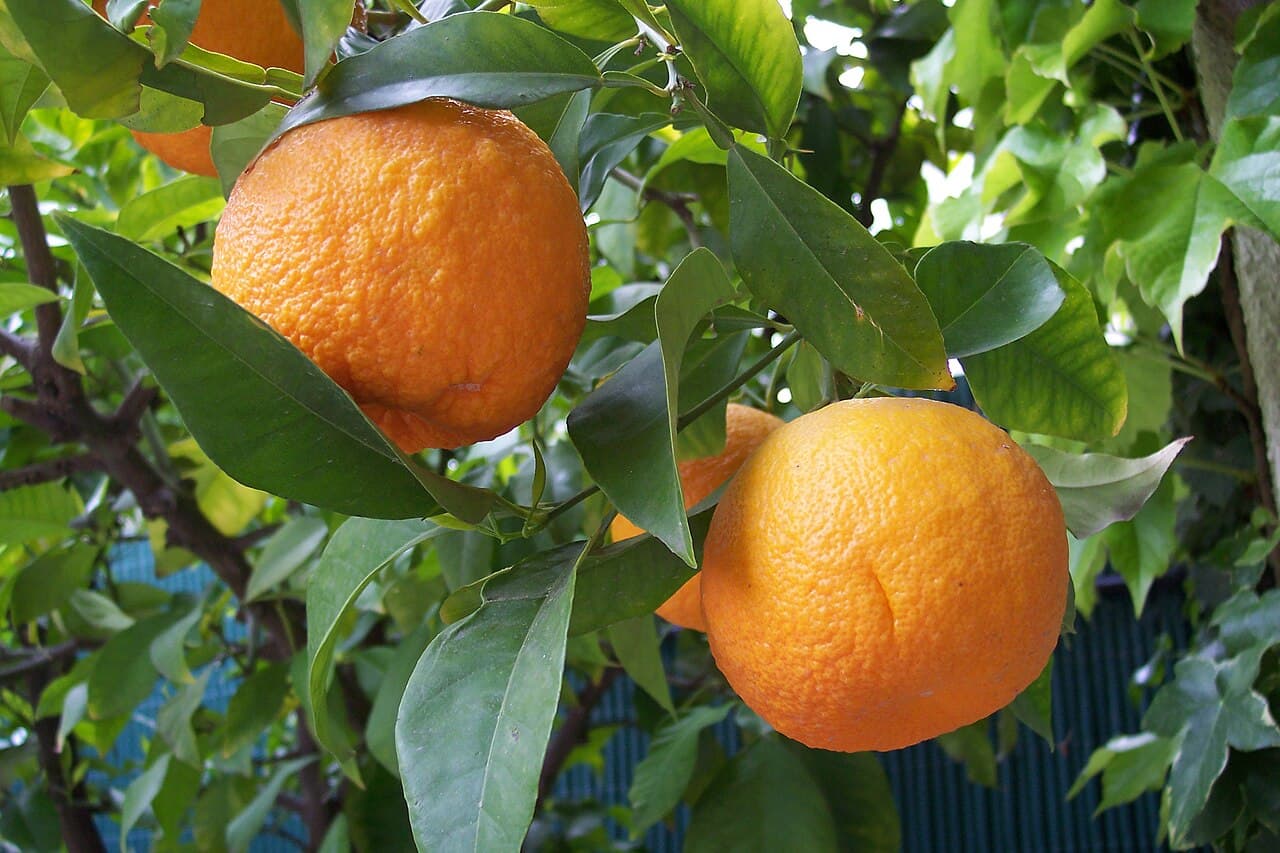
Citrus aurantium — the bitter orange. This is the original "naranj" that Arabs brought to Europe and gave the fruit its name across dozens of languages.
Wikimedia Commons — A. Barra
View sourcethe color that had no name
And then there's the color.
The sweet orange flooded European markets in the 1500s. Suddenly this intensely vivid, unmistakable fruit was everywhere — in market stalls and on dining tables and in sailors' rations — and the human brain did what it always does when it encounters a sensory experience it has no word for. It reached for the nearest physical object. The earliest recorded use of "orange" as a color word in English dates to 1502, in a dry description of clothing purchased for Margaret Tudor, daughter of Henry VII. Nobody at the time seems to have thought this was a momentous occasion; they just needed a word and the fruit was sitting right there. By the late 1600s Isaac Newton was using "orange" to name one of the seven colors of the visible spectrum during his prism experiments at Cambridge, and the deal was done. A Dravidian word for "fragrant fruit" had become an English word for a wavelength of light between 580 and 620 nanometers.
This isn't a quirk of English. It follows a pattern that turns out to be universal. In 1969 the linguists Brent Berlin and Paul Kay published a landmark study showing that all human languages acquire basic color terms in the same order: first black and white, then red, then green and yellow, then blue, then brown. Only after all of those — only at the very end of the sequence — do languages develop terms for purple, pink, orange, and gray. Orange is always late. It was late in every language Berlin and Kay surveyed. English was right on schedule. It just needed the fruit to arrive before it could name what it had been seeing all along.
the house of orange

The House of Orange-Nassau — named after a French town, named after a Celtic water god, branded by the color of an Indian fruit.
Wikimedia Commons — Preyer, David Charles, 1861-
View sourceAnd now for the part that makes no sense until it does.
The House of Orange. The Dutch royal family. The Orange Order in Ireland. The Orange River in South Africa. Koningsdag, when the entire Netherlands turns orange for a day and the canals fill with orange-painted boats and the streets are littered with orange confetti. None of it — not one bit of it — has anything to do with the fruit.
In 35 BCE the Romans established a settlement in southeastern France and named it Arausio, after a local Celtic water deity. Over the next thousand years Vulgar Latin sound laws ground that name down: Arausio became Aurenja became Orange. A completely independent phonetic evolution, having nothing to do with Sanskrit or Dravidian or any Arab merchant who ever lived. A Celtic water god and an Indian fruit arrived at the same English spelling by pure, dumb, unforeseeable coincidence.
But then dynastic inheritance did what dynastic inheritance always does. The town of Orange was the seat of a sovereign principality — a tiny, almost forgotten polity in the south of France. Through marriages and deaths and contested wills, the title Prince of Orange passed to William of Nassau-Dillenburg in 1544. He became William the Silent, leader of the Dutch Revolt against Spain, and he embraced the coincidence completely — his faction adopted the color orange as a heraldic pun, what heralds call a "canting symbol," and the rebel flag flew orange, white, and blue. His great-grandson William III crossed the English Channel and deposed James II in 1688. Irish Protestants founded the Orange Order in his honor in 1795. In 1779 a Dutch explorer named Robert Jacob Gordon christened a massive South African river system after William V of Orange, and it became the Orange River, and eventually the Orange Free State.
A Celtic water god named a French town. The French town named a Dutch dynasty. The Dutch dynasty colored half the world's Protestant institutions orange. And the color itself was named after a fruit from India whose name came from a Dravidian word meaning "fragrant." None of these things were supposed to connect. All of them do.
None of these things were supposed to connect. All of them do.
golden apple and the unrhymable word
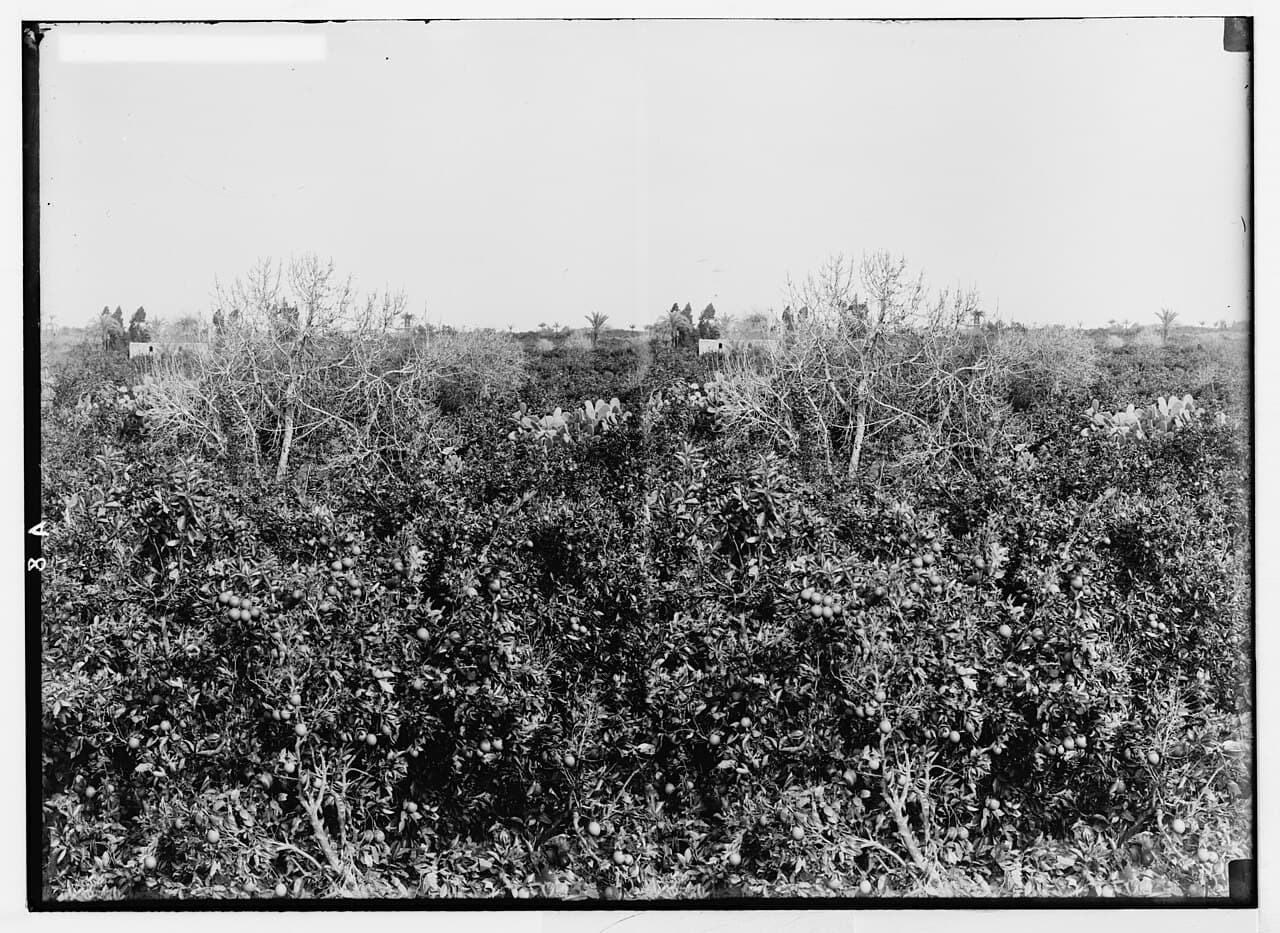
Jaffa oranges in the early 20th century — Hebrew speakers invented a new word for them: tapuz, from "tapuach zahav," golden apple.
Wikimedia Commons — Matson Collection
View sourceOne more thread. In modern Hebrew the word for orange is tapuz. It's a portmanteau — tapuach, apple, plus zahav, gold. Golden apple. When Hebrew revivalists in early 20th-century Palestine needed a modern word for the Jaffa oranges they were cultivating for export, they didn't borrow from Arabic or French or English. They built one from scratch, reaching all the way back to the ancient European habit of calling oranges golden apples — a tradition that predates the word "orange" itself by centuries.
And in English, the word "orange" has no perfect rhyme. Not one. The only legitimate candidate, acknowledged by the Oxford English Dictionary, is sporange — an archaic botanical term for sporangium, the structure where ferns produce spores. (There's also the Blorenge, a mountain in southeastern Wales, though that's more of a geographical curiosity than a solution to anything.) A word that crossed a dozen languages, lost a consonant to a medieval grammar glitch, named a color that had no name for a thousand years, and shares its spelling with a Celtic water god — of course it refuses to rhyme with anything. Some words carry too much to fit neatly into a couplet.
Some words carry too much to fit neatly into a couplet.